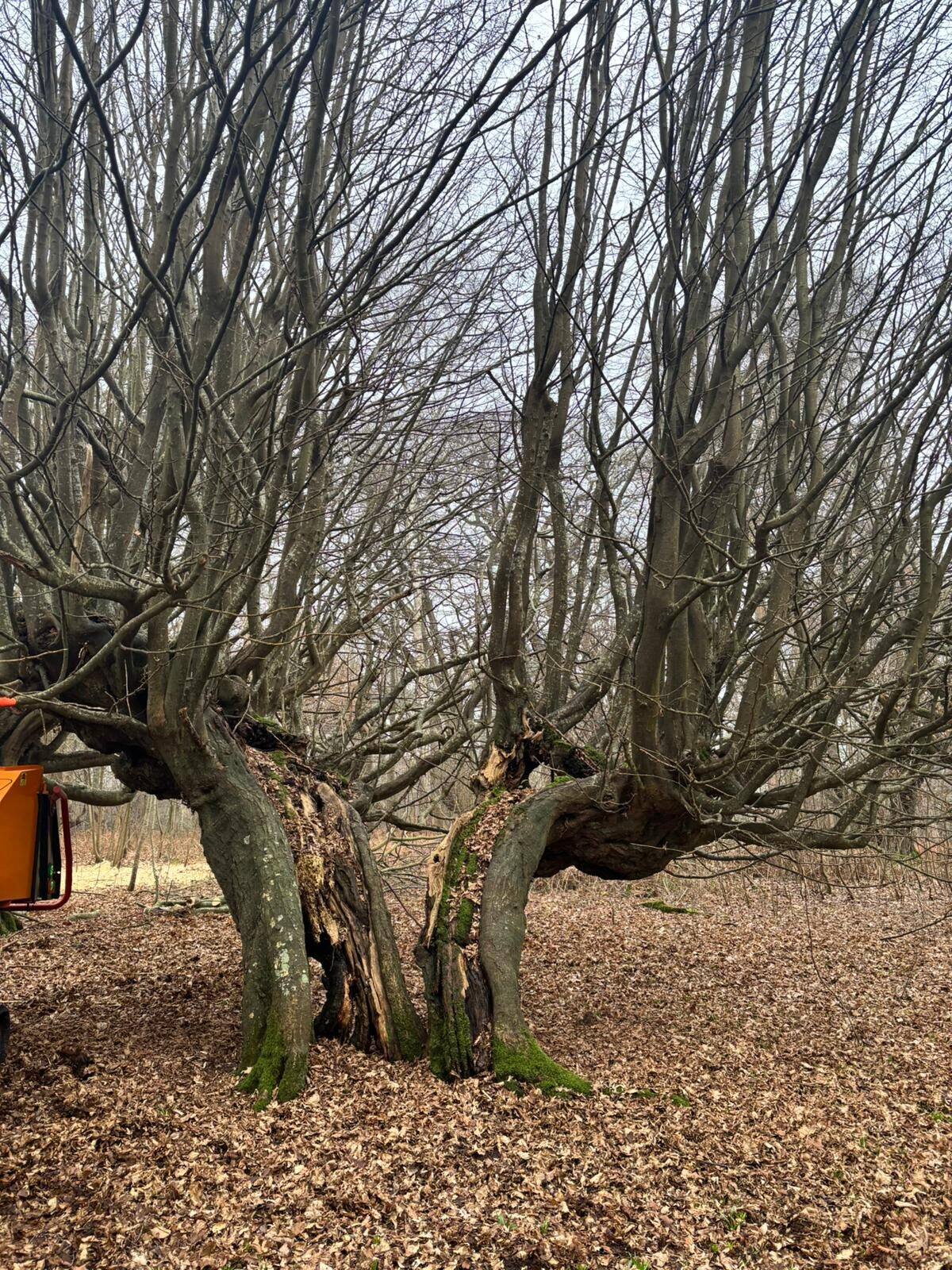
Heavy pruning for trees in tight spaces. Clean deadwood removal from established canopies. The kind of work where rope, rigging and a steady read of the tree matter as much as the saw.
Rigged & roped work
Pollarding is a deliberate, long-term way of keeping a tree at a manageable size in a space it's outgrown. Deadwood removal is the opposite — a light touch, high in the canopy, making trees safe without changing their shape. Both rely on a clean, climbed approach.
Serving Brighton, Hove, Ringmer, Lewes, Seaford, Shoreham, Henfield, Worthing and all surrounding BN postcodes.
01 — Pollarding
Pollarding is a severe tree pruning technique that involves lopping off most of a tree's branches where they meet the trunk. It's a way of controlling tree growth in confined spaces — keeping a mature tree where it needs to stay without taking it down.
It is a significant process, so each tree is given time to recover before the procedure may be repeated. Done to a good standard on the right species at the right time, pollarding can keep a tree healthy, manageable and characterful for decades.
02 — Deadwood Removal
Deadwood in trees can be hazardous, particularly if positioned above roads, footpaths, gardens or public access spaces. Removing it is a proactive way of making the tree safer without altering its living structure.
We climb around the entire canopy to remove dead branches — whether that's all deadwood over a given diameter, or a specification you've agreed with a surveyor. If you have a preferred standard, we can match it.
Signs to watch for
A shortlist of the scenarios that bring customers to this service — if any of them look familiar, it's probably time for a conversation.
Mature trees pinned between buildings, tight gardens, or over a boundary. Pollarding keeps them where they are — at a size you can maintain indefinitely — rather than forcing removal.
Dead limbs above a drive, a public footpath, a neighbour's garden. High-risk targets demand proactive removal before a storm decides for you.
If the tree was pollarded before, the regrowth needs taking back on cycle — typically every two to five years depending on species. Leave it too long and the new limbs get heavy and poorly attached.
Veteran specimens that have been pollarded for centuries — field oak, hornbeam, willow, lime — need continued sensitive work to stay stable. We work them to match the historic cutting pattern.
Ash dieback, honey fungus, bleeding cankers — compromised structure within an otherwise intact tree. Targeted deadwood removal keeps the living tree safe and buys time on decisions about the whole specimen.
Snapped limbs hanging in the canopy, split unions, bark tears. Rigging out the hangers and cleaning the damage before it becomes a second failure.
What to expect
From the first phone call to the last leaf cleared — the order of operations on a typical Branchwalkers job.
Free walk of the site. We look at the tree's structure, species, history (especially important for pollards — is it a known cycle or a first-time cut?), access, and what's beneath the canopy.
Within 48 hours. For pollards we'll specify the cut points and the reduction pattern; for deadwood we'll specify the minimum diameter being removed. RAMS produced for the crew.
Pollarding and deadwood work on TPO'd trees or in Conservation Areas both require notice. We prepare and submit the applications and liaise with the council — you don't touch the paperwork.
Lead climber on ropes, dedicated groundsman on the rigging. Sections lowered on friction devices — nothing free-falls. Pollard cuts made to the historic knuckle where one exists; first-time pollards made at the right height for the species.
Every chip cleared, lawns raked, driveways swept. All arisings taken off-site and recycled for biomass — nothing to landfill that doesn't have to go.
Recent Work
A Sussex woodland job on ancient hornbeams — rigging, climbing, and careful cut-by-cut shaping over several days. Click any image to enlarge.
In Sussex specifically
Sussex has a deep pollarding tradition — veteran hornbeam pollards in the weald, ancient field oaks on the Downs, willow pollards on the Pevensey Levels, and lime pollards that have been worked on village greens for three and four centuries. These trees aren't the same specimens as ornamental garden trees; they need a crew that understands the cycle, the species behaviour, and the fact that a 400-year-old pollard's next cut is a link in a chain. On the deadwood side, ash dieback is the single biggest driver of calls across East and West Sussex right now — we see it every week, and we'll always give you an honest read on whether a compromised ash is worth keeping, reducing, or felling. Timing: heavy pollard work is best in late winter just before bud burst, when the tree's reserves are ready to push regrowth; deadwood can be removed year-round, though we'll avoid active bird-nesting sites March to August.
Frequently asked
Straight answers to the questions that come up most often on site visits. Not here? Pick up the phone — we're happy to get into the detail.
On the right species, at the right time, and on a sensible cycle — yes, and it can extend the tree's life by decades. Pollarding the wrong species (it generally suits broadleaves like willow, lime, hornbeam, plane, poplar; avoid with most conifers and stressed specimens), doing it too hard, or abandoning the cycle are the things that cause problems. We advise on suitability before we cut.
Classic UK pollarding species — willow, lime, hornbeam, plane, poplar, ash (where healthy), beech (cautiously), oak (with a light touch and a plan). Fruit trees can tolerate heavy reduction but aren't traditionally pollarded. We'll give you an honest assessment on the day.
Most garden pollards are on a two-to-five-year cycle depending on species and vigour. Willow and poplar want it sooner; hornbeam and lime can often go longer. Veteran pollards are worked on their historic rhythm — some are on ten-year cycles. We'll give you a realistic interval on the quote.
Any dead branch material still attached to the tree. Small-diameter deadwood is a natural part of a healthy canopy and often left; anything larger — typically over 25mm — over a target (footpath, road, garden, outbuilding) is removed on safety grounds. We work to whatever minimum diameter a surveyor has specified, or use our own judgement.
Sometimes — but it's a significant intervention and not every species or every specimen is a candidate. A previously unpollarded mature beech, for example, generally won't recover well; a mature plane or lime often will. We'd survey the tree first and give you a realistic assessment before committing.
Yes — that's the point. Suitable species respond with vigorous regrowth from the pollard knuckle within a growing season. The new shoots build the 'boll' (the pollard head) over years, and the cycle continues. Skipping cycles or overdoing single cuts breaks the pattern.
Pollarding is a managed, repeated, deliberate technique that cuts to a specific point and is repeated on a cycle the tree is ready for. Topping is a one-off, usually ignorant cut that lops the tree down without regard for regrowth points or the cycle that follows. Pollarding is good arboriculture; topping is damage.
Yes — we handle the paperwork. For a TPO we submit an application and wait for the decision. For a Conservation Area we submit a six-week notification. Either way, you don't touch the council inbox — we do it as part of the job.
Adjacent services
Less drastic shaping when you want the tree to stay, just smaller or lighter.
When a tree has to come down — safe, rigged dismantling and full stump grinding.
Full council paperwork handled — surveys, applications, felling licences. Stress-free.
Verified feedback
Independently verified reviews on Checkatrade — filter by the kind of work to see how Branchwalkers handled it before.
Read client reviewsWhether it's a single garden pollard or an ancient woodland specimen, we'll walk the site, talk you through the plan, and quote transparently.
0800 567 7433Or request a quote online — replies within 48 hours